By Marine Conservation Institute | October 14, 2025
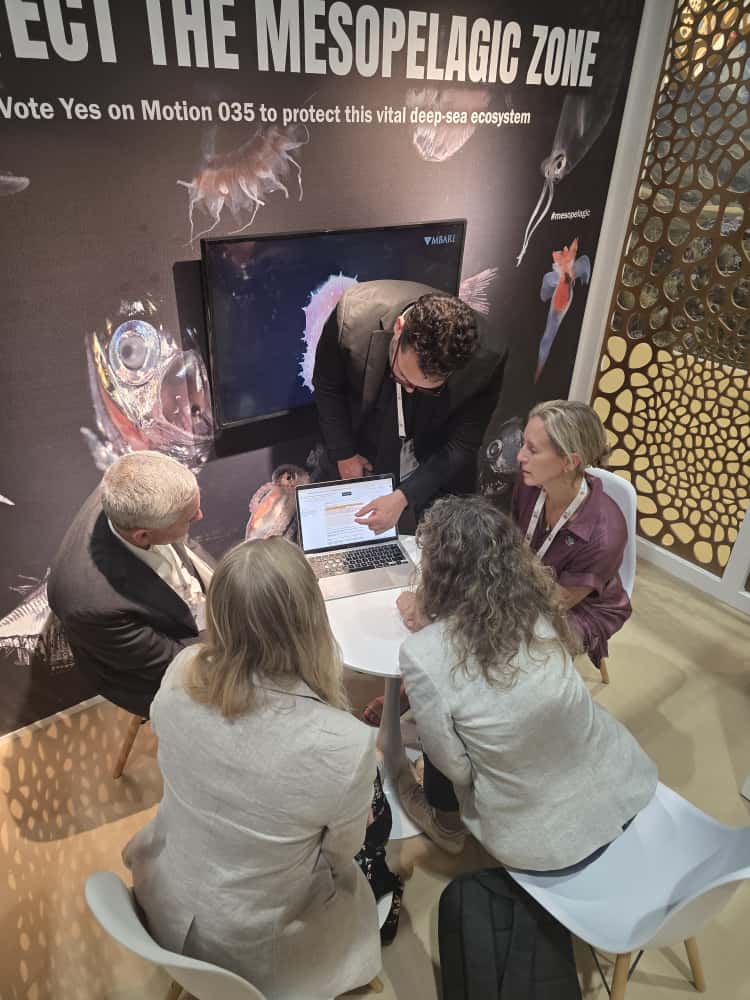
Today, the International Union for Conservation of Nature (IUCN) voted to pass Motion 035, “Protection of mesopelagic ecosystem integrity,” at the World Conservation Congress in Abu Dhabi. This landmark decision calls for applying a precautionary approach to the expansion of mesopelagic fishing while we work to better understand the adverse impacts of human activities on this vast and vital ecosystem.
Video posted by IUCN highlighting the passage of the motion to protect mesopelagic ecosystems.
The mesopelagic—or “Ocean Twilight Zone”—extends from roughly 200 to 1,000 meters deep and is home to an immense portion of the ocean’s life, possibly up to 90 percent of its biomass. Every night, many of these organisms migrate toward the surface to feed, playing an essential role in transporting and sequestering billions of tons of carbon each year—an invisible but powerful process that helps regulate Earth’s climate.
“The mesopelagic zone is one of the planet’s largest and least understood ecosystems. Its species are critical to maintaining biodiversity, climate regulation and food web stability across the ocean,” said Dr. Lance Morgan, President of Marine Conservation Institute.
Ms. Elle Bent, High Seas Project Coordinator for Marine Conservation Institute, who participated in the motion’s development, stated, “By passing this motion, the IUCN and its members have taken a forward-looking step toward precautionary, science-based stewardship of a system that underpins the health of our planet.”
The passage of Motion 035 underscores the growing global recognition that a healthy ocean requires protecting even the deep and unseen. Dr. Morgan, summarized the significance of the vote, “With this decision, the international community is signaling its commitment to ensuring the mesopelagic remains a thriving, living engine of climate stability and biodiversity.”